MAE 4700 · Cornell University · 2-person Team (Member)
I led the problem framing, mathematical modeling, mesh refinement strategy, and design comparison computations for an FEA-based parametric optimization of a NACA 0012 wing blade in ANSYS, achieving a 41.8% weight reduction while satisfying all stress and deflection constraints.
Situation
Outcomes
The Problem
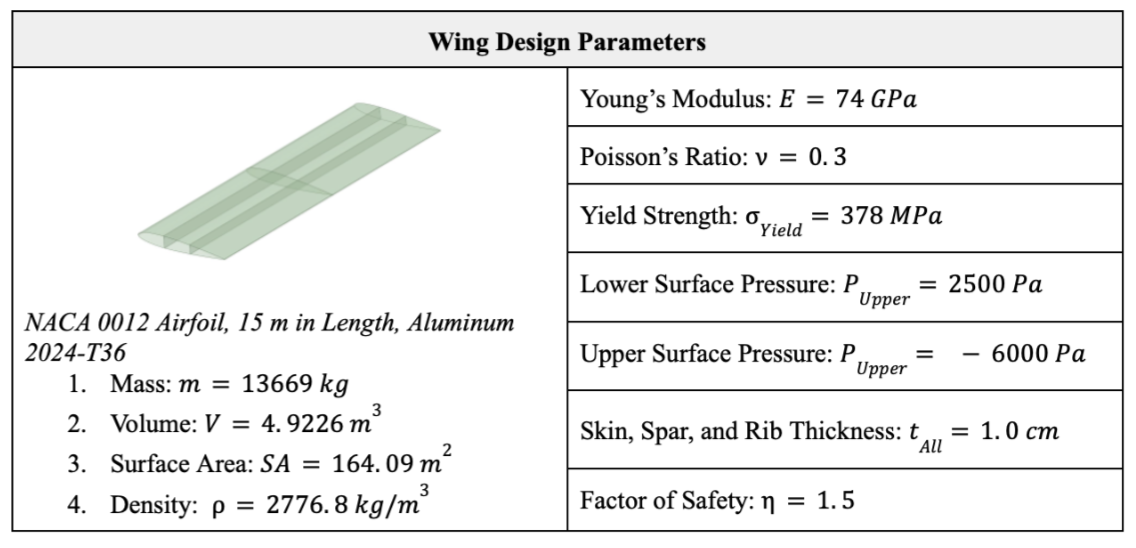
Wing blade weight reduction is a standard structural optimization problem in aerospace design, and finite element analysis is the standard tool for evaluating it. The blade analyzed here is a NACA 0012 airfoil, 15 m in span, made of Aluminum 2024-T36, subject to a lower surface pressure of 2,500 Pa and an upper surface pressure of negative 6,000 Pa representing typical aerodynamic loading. The starting design has a mass of 13,669 kg with 1 rib and 2 spars, all components at a uniform thickness of 1.0 cm.
The optimization problem has three hard constraints: maximum Von Mises stress below 252 MPa (yield strength of 378 MPa divided by a factor of safety of 1.5), maximum tip deflection below 0.375 m (2.5% of span), and no changes to the external mold line, span, aspect ratio, or outer geometry. The design variables available within those constraints are the thickness of the skin, spars, and ribs, and the number and placement of ribs and spars. The study systematically varied these inputs across four structural configurations to identify the combination that minimized total weight.
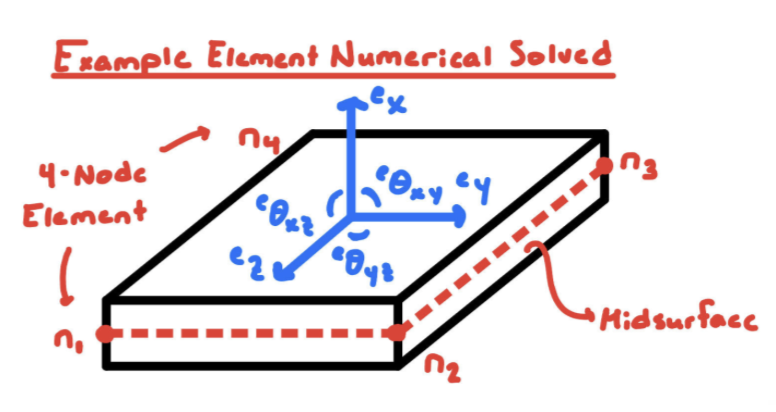
The blade is modeled using Thin Shell Theory, which simplifies the 3D structure to a 2D mid-surface by removing the thickness dimension from the geometry. This is valid because the wall thickness is much smaller than the overall blade dimensions, and it is consistent across all components. The mid-surface representation eliminates thickness-direction elements from the mesh, significantly reducing the number of degrees of freedom the solver must evaluate while still capturing the dominant structural response.
The Principle of Minimum Potential Energy governs the mechanical response of the shell elements, driving ANSYS to find the deformation state that minimizes total potential energy. This is formulated analogously to a multi-element spring system, where strain energy and external work terms are summed across all discretized shell elements. Each 4-node shell element contributes 24 degrees of freedom (6 per node: 3 translational and 3 rotational), and the global stiffness matrix is assembled from the element-level stiffness contributions based on Young's modulus, Poisson's ratio, and moment of inertia.
Singularities arise at mid-surface intersections where two shell planes meet. At these locations, the effective thickness is doubled in the automatic mesh, producing artificially elevated stress concentrations. Manual and adaptive mesh refinements were applied specifically at these locations to correct this behavior.
Three mesh strategies were evaluated to verify that the solution was mesh-independent before running the full parameter sweep. The automatic ANSYS mesh produced 21,013 elements and 19,834 nodes but contained singularities at mid-surface intersections where two shell planes overlap. A manual sphere-of-influence refinement targeted these locations, increasing the element count to 27,833 elements and 26,516 nodes and producing a more physically accurate stress distribution in the affected regions.
An adaptive Von Mises stress-based refinement was applied as the final step, concentrating additional elements in high-stress regions identified from the previous solution. This produced 32,754 elements and 31,620 nodes. The tip deflection converged closely across all three methods, however the Von Mises stress increased substantially from 97.1 MPa to 143.2 MPa as singularity artifacts were resolved. The adaptive mesh was used for all subsequent design comparisons, as it produced the most physically consistent stress field.
Mesh Comparison (Baseline Geometry)
| Auto mesh | 21,013 elements · 97.1 MPa |
| Sphere of influence | 27,833 elements · 121.9 MPa |
| Adaptive Von Mises | 32,754 elements · 143.2 MPa |
| Tip deflection (all) | ~0.2275 m (converged) |
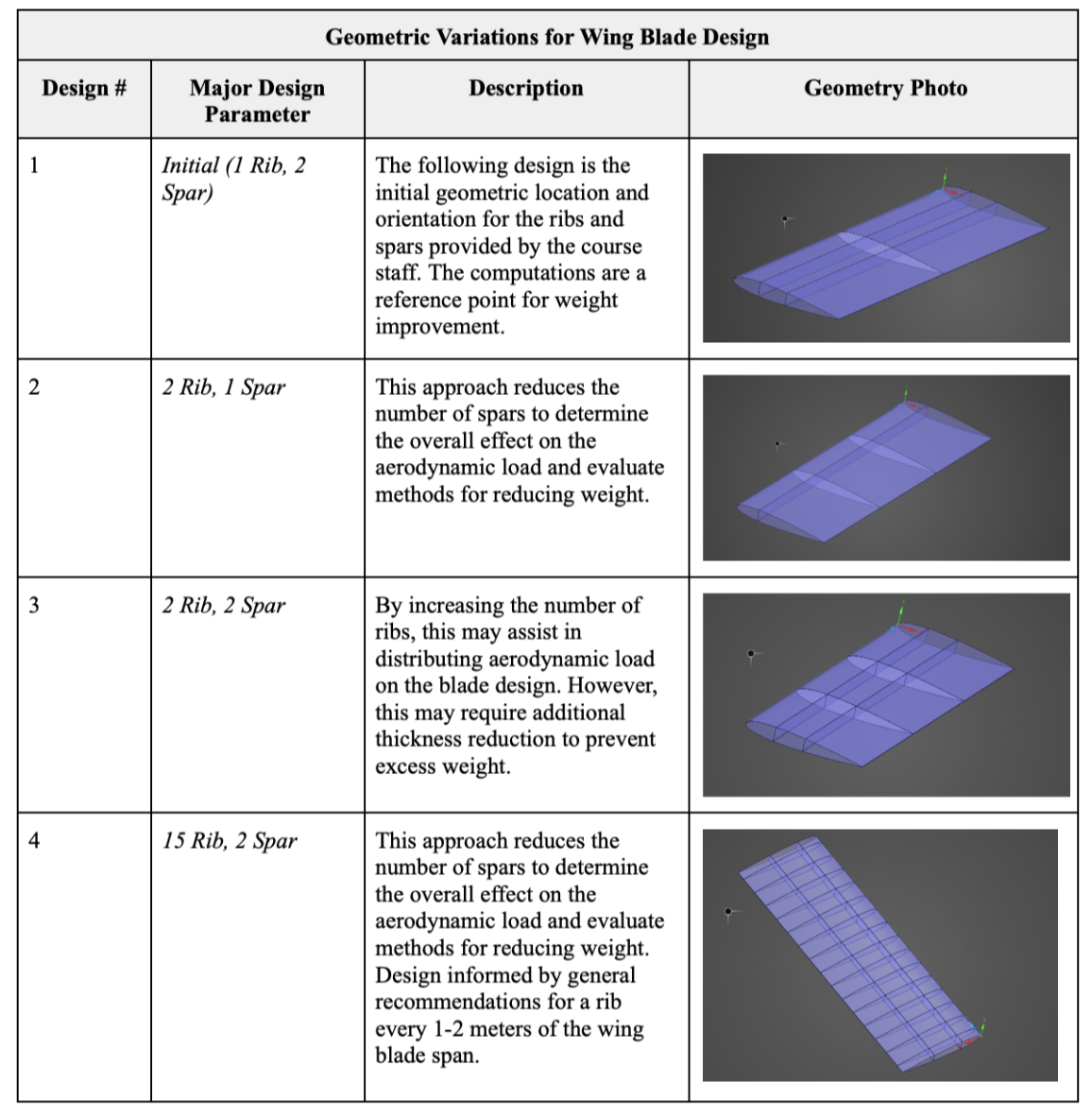
Four structural configurations were evaluated, each with multiple sub-variants produced through ANSYS parametric sweeps on skin, spar, and rib thickness. Each variant was assessed against the three constraints (Von Mises stress, tip deflection, factor of safety) and the best feasible point within each configuration was identified. The parameter sweep for each design included approximately four to five candidate points, for a total of roughly 25 ANSYS simulations across the full study.
Design 1 (1 rib, 2 spars) is the baseline at 11,039 kg. Design 2 (2 ribs, 1 spar) removed a spar to reduce material, however the resulting stress concentration required compensating thickness increases elsewhere, producing a heavier result at 12,345 kg. Design 3 (2 ribs, 2 spars) demonstrated that adding ribs distributes the aerodynamic load more evenly, enabling modest thickness reductions and dropping total weight to 10,797 kg. Design 4 (15 ribs, 2 spars) extended this logic fully: spacing ribs approximately every 1 m along the span reduced the structural demand on the skin and spars enough that their thicknesses could be cut substantially, reaching 7,955 kg and a 41.8% weight reduction from the baseline.
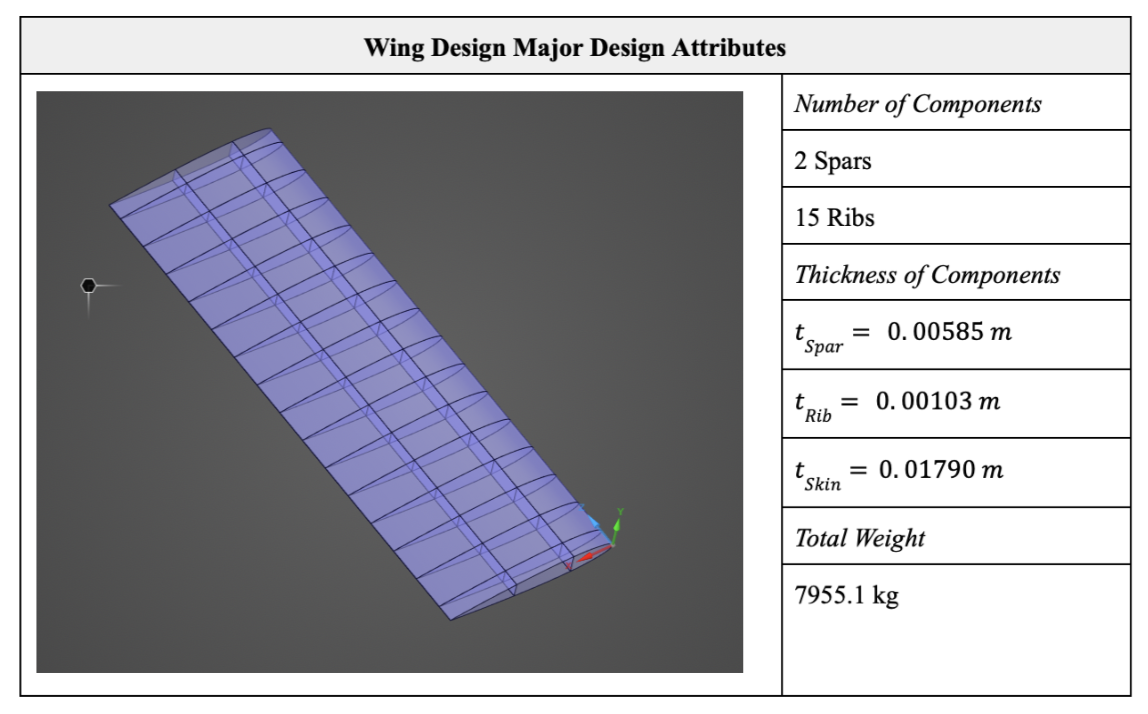
The final design uses 15 ribs spaced approximately every 1 m along the span and 2 spars, with spar thickness of 5.85 mm, rib thickness of 1.03 mm, and skin thickness of 17.9 mm. This configuration produced a total mass of 7,955 kg, a 41.8% reduction from the 13,669 kg baseline.
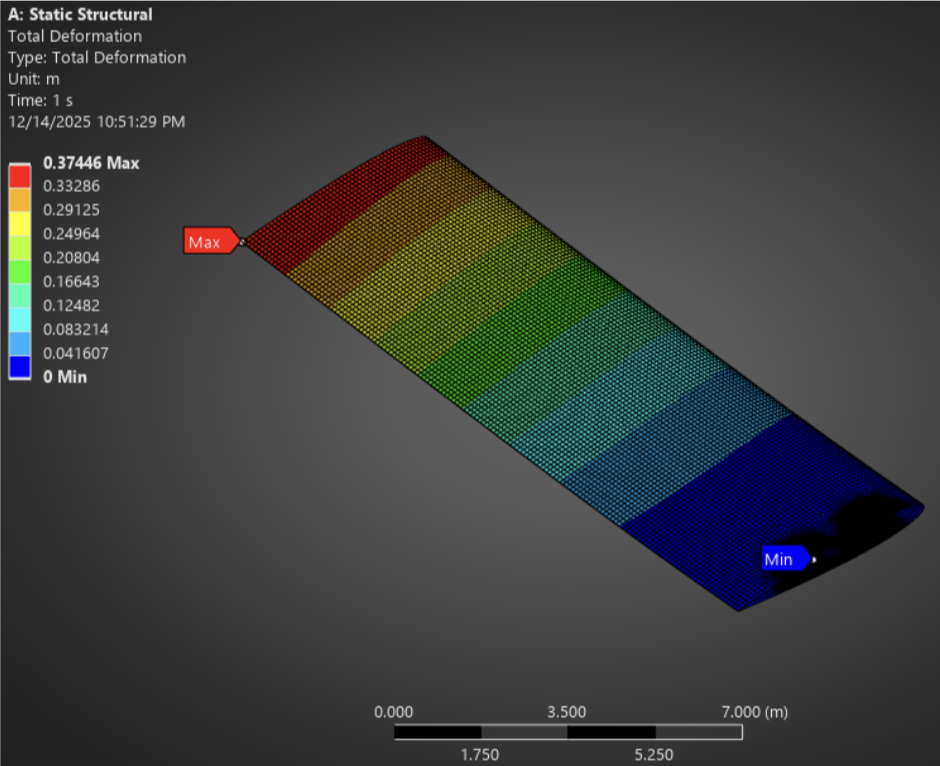
All design constraints were satisfied. Maximum tip deflection reached 0.374 m, just inside the 0.375 m limit. Von Mises stress after applying the factor of safety was 156.9 MPa, below the 252 MPa allowable. The factor of safety was 1.61, above the 1.5 minimum.
The 1.03 mm rib thickness is significant because it approaches the practical manufacturing floor for structural aluminum. The nearest standard commercial sheet thicknesses are 1/32 inch (1.02 mm) and 1/16 inch (1.59 mm). A rib thinner than 1.02 mm would not correspond to any commercially available aluminum sheet gauge, which means the optimization has converged on a realistic lower bound rather than an arbitrary numerical minimum. This grounds the result in actual manufacturing constraints and supports the conclusion that further geometric reduction is not practically achievable with this material and configuration.
The primary finding is that rib count is the most effective lever for weight reduction in this blade configuration. Increasing from 2 to 15 ribs distributed the aerodynamic load more evenly along the span, which reduced the structural demand on the skin and spars and allowed their thicknesses to be reduced substantially. Removing a spar, by contrast, increased stress concentration and required compensating thickness increases elsewhere, producing a net weight increase. The two-spar configuration was retained in the final design because it produced consistently lower maximum stress across all parameter variations.
Future work could extend this analysis in several directions. Testing additional rib counts beyond 15, or non-uniform rib spacing tuned to the bending moment distribution, may yield further reductions. Substituting higher strength-to-weight materials such as carbon fiber composites would allow further thickness reduction below the current aluminum sheet floor. Additionally, the current model assumes constant chord, so exploring tapered or swept planform geometries would introduce additional design freedom not available in this parameterization.
Project Documents