← Back to Projects

Nozzle Geometry Optimization for Chocolate 3D Printing

I wrote the problem statement, built the physical schematics in Fusion360, determined the Cross-WLF viscosity model for non-Newtonian chocolate flow, and led the COMSOL model validation and sensitivity analysis for this finite-element study of chocolate extrusion nozzle geometry.
COMSOL Multiphysics Finite Element Analysis Non-Newtonian Fluid Flow Cross-WLF Viscosity Model Heat Transfer Fusion360 Chocolate Rheology Sensitivity Analysis Model Validation
Situation

  • Commercial chocolate 3D printers such as the Cocoa Press 1 do not achieve in-nozzle tempering. They rely on pre-tempered material, leaving it unknown whether any nozzle geometry modification could enable proper crystallization during extrusion.
  • Chocolate is a non-Newtonian, shear-thinning fluid with strong temperature-dependent viscosity. Standard Newtonian flow models are not applicable, requiring a specialized rheology model.
  • No published FEA model characterized coupled thermal and fluid behavior inside a chocolate extrusion nozzle, and no systematic geometric sensitivity study existed for this application.

My Contributions

  • Authored the problem statement and research objectives, framing tempering feasibility as the primary research question.
  • Designed the axisymmetric nozzle geometry in Fusion360 and produced all physical schematics for the boundary conditions and governing equations.
  • Selected and implemented the Cross-WLF viscosity model in COMSOL, fitting constants from published 70% dark chocolate rheological data.
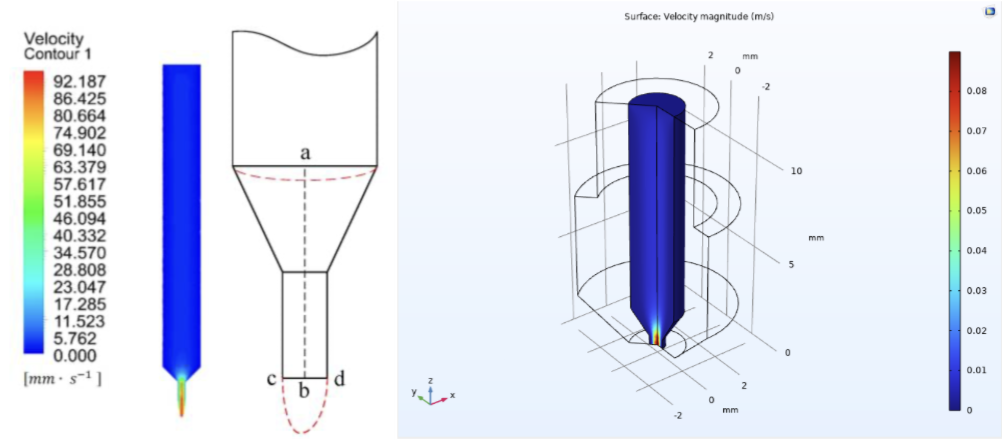
  • Validated the model against published PEEK plastic extrusion data from Wang et al., confirming velocity and temperature trends matched the literature.
  • Ran the full sensitivity analysis across nozzle diameter (0.8 to 1.6 mm) and length (8 to 16 mm) and interpreted the results to determine that geometry alone cannot achieve in-nozzle tempering under current operating conditions.

The Problem

Chocolate tempering is the process of precisely controlling melting, cooling, and reheating to stabilize specific cocoa butter crystal structures. Properly tempered chocolate produces the characteristic gloss, snap, and structural strength found in commercial confectionery. Without controlled crystallization, 3D-printed chocolate parts are softer, warp more easily, and lose fine surface detail.

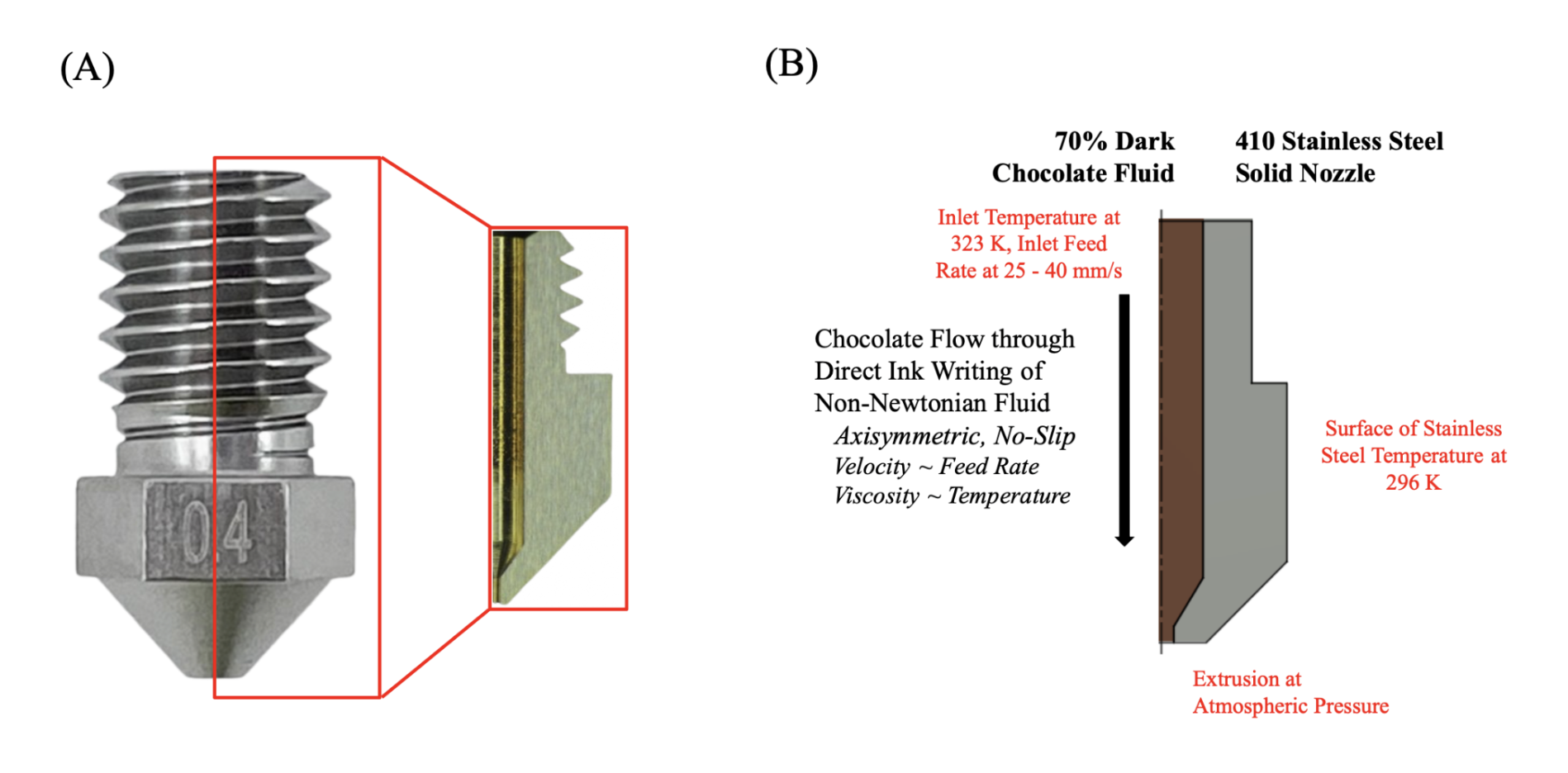
The Cocoa Press 1 is a commercially available chocolate 3D printer that uses a heated reservoir and motor-driven plunger to extrude solid chocolate logs through a stainless steel nozzle. The system does not explicitly advertise in-nozzle tempering and instead relies on pre-tempered chocolate loaded into the cartridge. The printer attempts to maintain the material within an extrudable temperature range, but it is not known whether the nozzle geometry can produce outlet temperatures consistent with the tempering window (approximately 306 K), or whether any geometric modification could enable this.

The project objective was to determine, through coupled FEA in COMSOL, whether iterating through nozzle diameters and chamber lengths could bring outlet temperatures into the tempering range, and to identify what process modifications would be required if geometry alone is insufficient.

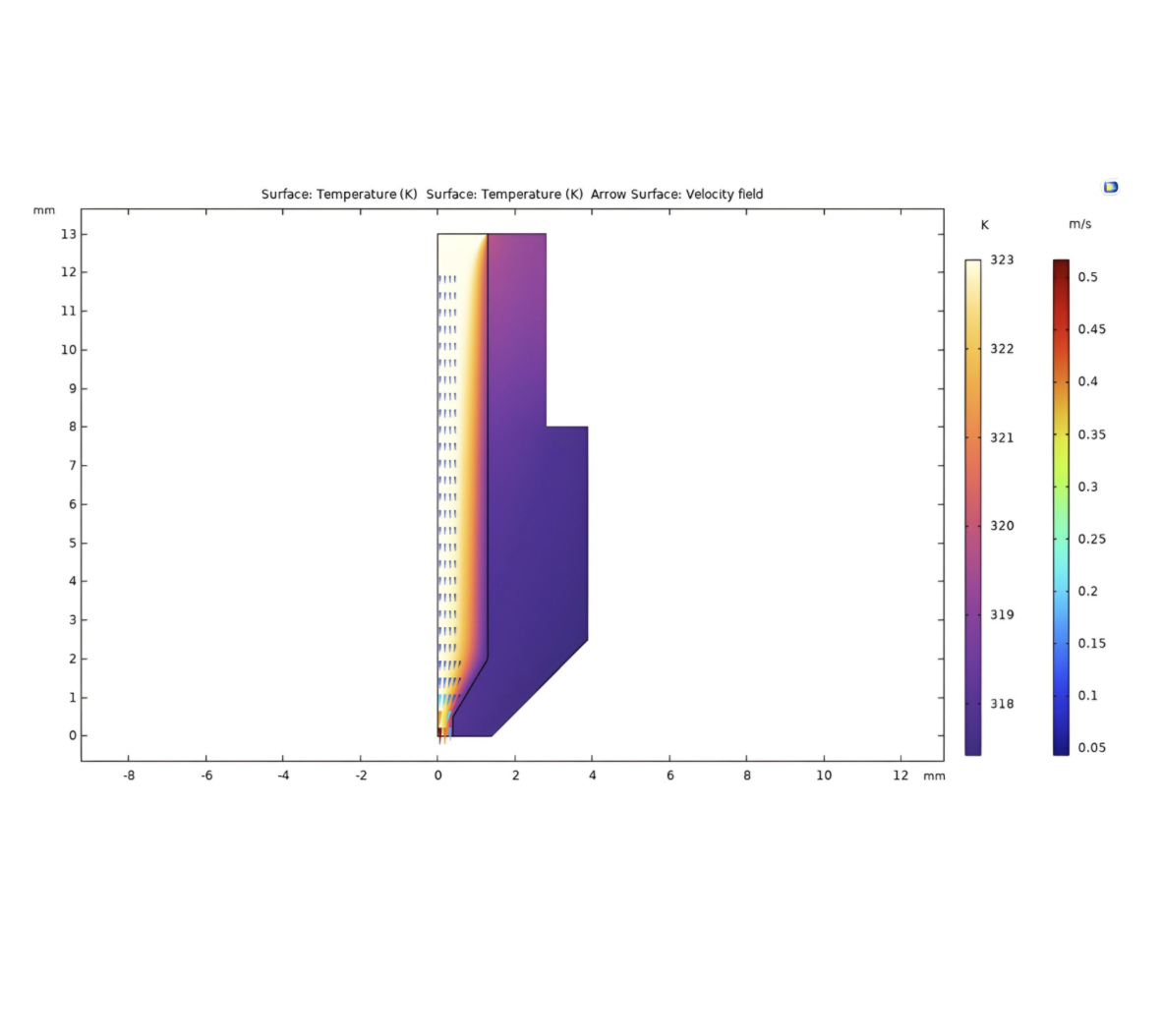
The physical system was modeled as an axisymmetric cross-section of the Cocoa Press nozzle and the liquid chocolate flowing through it. Rotational symmetry reduces the 3D problem to a 2D domain, capturing both radial and axial behavior while significantly reducing computational cost. Liquid chocolate enters the cartridge body at a controlled inlet temperature and is driven downward by the motor-actuated plunger toward the converging nozzle tip.

As the chocolate moves through the nozzle, heat is transferred through the stainless steel walls by conduction and lost to the surrounding environment through convection. The outlet temperature is the primary variable of interest, as it determines whether the chocolate exits within the tempering window.

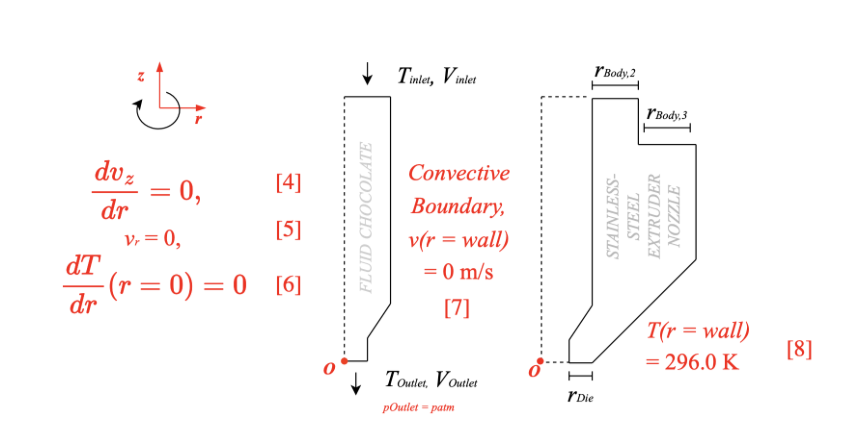
The schematics were built in Fusion360 and define the geometry and boundary conditions used in COMSOL. The chocolate and stainless steel domains are defined separately, with interface conditions applied at the fluid-wall boundary. Inlet velocity and temperature are specified at the cartridge entry, atmospheric pressure is applied at the outlet, and a convective heat transfer coefficient of 8.65 W/m^2K is applied to the exterior nozzle surface. No-slip conditions are applied at all fluid-wall boundaries. The model uses a fully coupled steady-state Laminar Flow and Heat Transfer in Fluids physics setup.

Chocolate is a non-Newtonian fluid with shear-thinning behavior, meaning its viscosity decreases as shear rate increases. Standard Newtonian models are not applicable. The Cross-WLF model was selected because it captures both shear rate dependence and temperature dependence in a single formulation. The Cross portion of the model accounts for shear-thinning behavior. The WLF (Williams-Landel-Ferry) portion accounts for the exponential dependence of viscosity on temperature.

This model is established in FDM simulation literature for thermoplastic materials, and the extrapolation to chocolate-based FDM is valid given the similar extrusion mechanism. Published rheological data for 70% dark chocolate was used to extract the required constants. A linear regression was applied to the viscosity-shear dataset to reconstruct the experimental curve and identify the critical shear stress, power-law index, reference viscosity, glass transition temperature, and WLF coefficients. The resulting model was implemented in COMSOL as a user-defined viscosity function referencing the internally computed shear rate (spf.sr).

Cross-WLF Constants (70% Dark Chocolate)

Critical shear stress (t*)168 Pa
Power-law index (n)0.6226
Reference viscosity (D1)6 Pa·s
Glass transition temp. (D2)298.15 K
Empirical coefficient (A1)10
Temp.-shift coefficient (A3)51.6
Inlet temperature323 K
Inlet velocity25.0 mm/s
Outlet pressure101325 Pa

To verify that the governing equations, boundary conditions, and COMSOL implementation were correct before applying the model to chocolate, the chocolate material properties were replaced with PEEK plastic properties from Wang et al. PEEK is a high-performance thermoplastic commonly used in FDM simulation studies, with published velocity and temperature profiles available for direct comparison. The goal was not to match exact values, but to confirm that the model produces the correct physical behavior.

The simulated PEEK model produced a peak centerline velocity of approximately 0.88 m/s and an average outlet temperature of approximately 482 K. Wang et al. report a peak exit velocity of approximately 90 mm/s and an outlet temperature range of 400 to 500 K. Both the velocity distribution and temperature behavior were consistent with the published results. Additionally, the parabolic velocity profile across the nozzle exit, the acceleration through the converging section, and the viscosity decrease at the nozzle tip all matched the qualitative trends described in the literature. These results confirm that the model infrastructure correctly represents the intended physics, and the approach is transferable to the chocolate case.

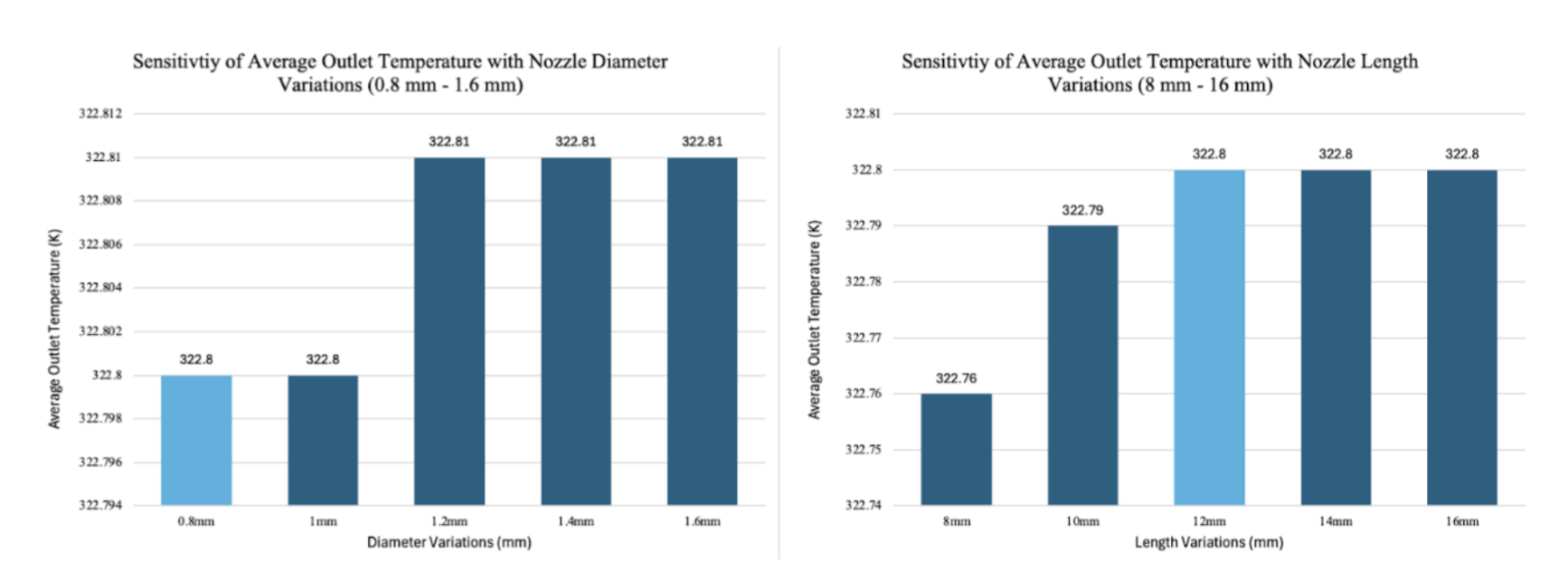
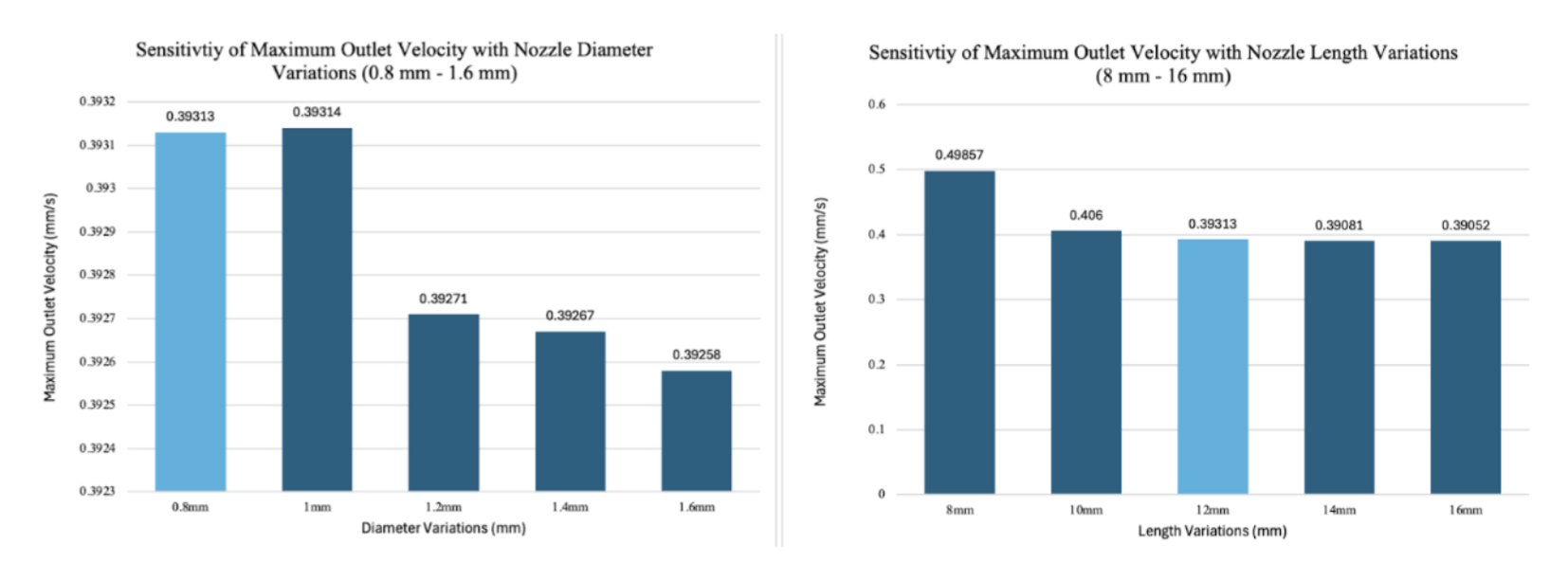
With the model validated, a systematic sensitivity analysis was run to evaluate the effect of nozzle geometry on outlet temperature and peak velocity. Nozzle diameter was varied from 0.8 mm to 1.6 mm in 0.2 mm increments. Nozzle length was varied from 8 mm to 16 mm in 2 mm increments. All other parameters, including inlet temperature, inlet velocity, and wall boundary conditions, were held constant at the Cocoa Press baseline operating conditions.

Outlet temperature showed minimal sensitivity to both diameter and length. The thermal behavior is dominated by the inlet temperature and wall boundary conditions rather than the nozzle geometry. Larger diameters produced a slight increase in outlet temperature, consistent with a larger fluid volume being more resistant to cooling at the same wall boundary, however the magnitude of the effect was small. Length had no discernible effect on outlet temperature within the range tested.

Peak velocity showed strong sensitivity to nozzle length but weak sensitivity to diameter. Longer nozzles produced lower peak velocities as the flow had more distance to develop and viscous resistance accumulated. Beyond approximately 12 to 14 mm, peak velocity leveled off, indicating that the flow had reached a fully developed state. These results confirm that nozzle geometry meaningfully influences flow behavior but does not provide sufficient thermal control to bring outlet temperature into the tempering window of approximately 306 K. Geometry alone is not a viable path to in-nozzle tempering under current operating conditions.

318 K
Simulated outlet temp. (baseline)
306 K
Target tempering temperature
25
COMSOL configurations simulated

The primary finding is that the Cocoa Press 1 does not achieve chocolate tempering through its nozzle geometry. Across all tested configurations, outlet temperatures remained near 318 to 322 K, well above the tempering window of approximately 306 K. Variation in nozzle diameter and length within the practical range did not meaningfully alter this result. The thermal behavior is dominated by the inlet temperature and wall boundary conditions, not by the nozzle geometry itself.

Two recommendations follow directly from the analysis. First, active cooling applied to the exterior of the nozzle, particularly near the die exit, would provide a direct mechanism for reducing outlet temperature and potentially bringing it into the tempering range. Second, upstream tempering prior to loading the chocolate into the cartridge remains the most reliable approach for achieving proper crystal structure, which appears to be the implicit assumption behind the current Cocoa Press design. The nozzle in its current form primarily functions as a flow control mechanism, not a thermal regulation mechanism.

The validated model is documented and available as a reference baseline for future nozzle design work. Extensions of this analysis could include active cooling simulations, time-dependent startup behavior, or material substitution to evaluate alternative chocolate formulations with different rheological profiles.